
How do you dispose of fresh flowers after a funeral?
To dispose of fresh flowers after a funeral, keep any blooms you want to preserve, separate flowers and foliage from their supports, and compost suitable plant material or use your council’s accepted waste route. For arrangements left at a cemetery or crematorium in 2026, check the site’s removal rules before taking anything away; floral foam, wire, ribbon and wrapping need separate handling.
- How do you dispose of fresh flowers after a funeral? Separate keepsakes, compostable stems and non-compostable supports.
- Ask the cemetery or crematorium before removing tributes, and check your council’s garden-waste rules.
- Stemsfromheaven offers artificial funeral flowers for families who prefer a lasting tribute; fresh flowers remain a personal choice.
Why this matters
A funeral tribute contains more than flowers. Ribbon, wire, plastic trays and floral foam need different handling from petals, leaves and stems, so putting the whole arrangement into garden waste is not the right approach.
You do not have to keep every flower to honour the person who has died. Whether you chose fresh tributes or Stemsfromheaven artificial funeral flowers, deciding what to keep, share or clear away is a personal choice.
How do you dispose of fresh flowers after a funeral?
Separate the tribute before choosing a disposal route. Start with the family’s wishes, then check who is responsible for flowers left at the venue or graveside.
Ask before removing anything
Speak to the closest family member or person arranging the funeral before dismantling shared tributes. Someone might want a particular rose, a message card or a ribbon bearing a name.
For flowers still at the funeral venue, ask the funeral director, cemetery or crematorium what happens next. Confirm the site’s current 2026 arrangements rather than relying on what happened at a previous funeral. Ask where flowers are displayed, who removes them and whether the family can collect them beforehand.
Set aside flowers and messages to keep
Remove cards and ribbons before they become wet or difficult to read. Photograph the whole tribute if its shape, colours or wording hold particular meaning.
Choose any flowers you want to dry or press while they are still in suitable condition. Flowers already affected by mould are not a good choice for a keepsake; a photograph or message card offers another way to remember the tribute.
Separate the materials carefully
Work on a covered surface and wear gardening gloves when handling wired arrangements. Lift out stems gently, watching for cut wire, pins and sharp ends hidden beneath the foliage.
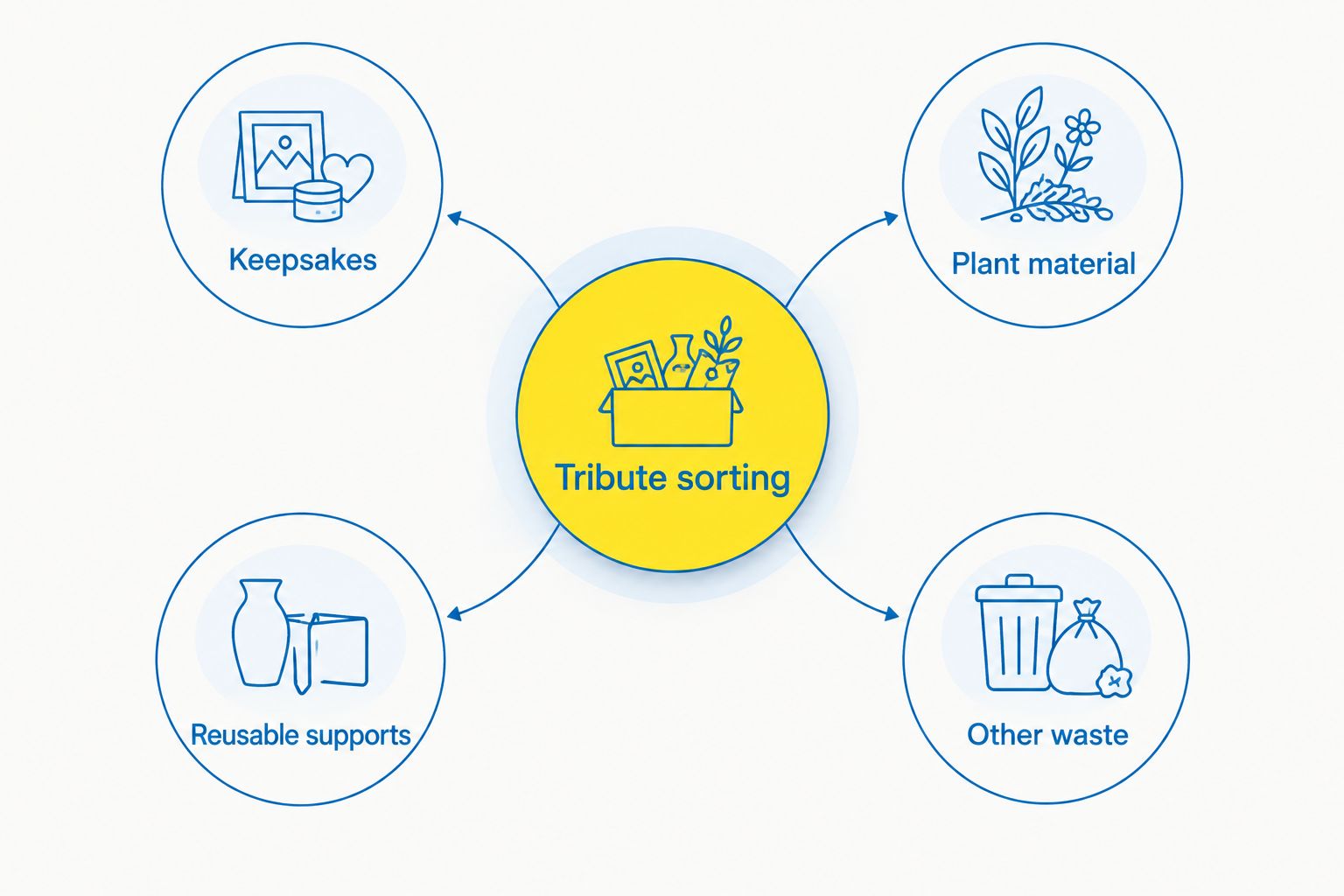
Sort the tribute into these groups:
- Keepsakes: selected flowers, cards and meaningful ribbons.
- Plant material: loose flowers, leaves and stems, with supports removed.
- Reusable supports: sound containers, frames and other parts you intend to keep.
- Other waste: floral foam, damaged wrapping and components that cannot be reused or accepted for recycling.
Compost suitable flowers or check the collection rules
Clean, untreated cut flowers and foliage can go into a home compost heap. Remove wire, plastic, ribbon, glittered decorations and floral foam first; do not assume an entire arrangement is compostable because its flowers are natural.
For a council collection or household waste recycling centre, check the accepted-material list for your area in 2026. Garden-waste and food-waste services have different rules, and permission to include cut flowers does not mean permission to include their packaging.
Deal with the remaining supports separately
Keep usable containers or frames only if you want them. For anything else, follow your council’s instructions for that material; a plastic-looking item is not automatically suitable for household recycling.
Do not add conventional floral foam to compost or garden waste. Collect loose pieces rather than rinsing them down the sink, and follow local disposal guidance.
Keeping, sharing or composting: which option fits?
You can divide an arrangement between several purposes. Keeping a flower does not prevent you from composting the remaining stems, and sharing a bouquet does not mean giving away a card you want to retain.
| Option | Best for | Benefit | Limitation |
|---|---|---|---|
| Keep selected blooms | Families wanting a small keepsake | Retains a physical connection to the tribute | Not every flower dries or presses well |
| Share fresh stems | Relatives who would welcome flowers at home | Lets more than one household keep part of the tribute | Flowers need to be in suitable condition |
| Offer flowers for donation | Arrangements an organisation has agreed to accept | Gives usable blooms another purpose | Acceptance must be confirmed first |
| Compost separated plants | Flowers that are no longer wanted for display | Returns suitable plant material to compost | Foam, wire and decorations must be removed |
| Reuse sound supports | People planning another arrangement | Keeps a usable frame or container in use | Damaged or unsuitable components need disposal |
Choose the route that feels manageable, not the one that creates the most work. Ask a relative or friend to help if sorting the flowers feels difficult.
Keeping flowers as a memorial
Pressing selected petals or drying suitable stems lets you retain a small part of a larger tribute. Both methods change the flowers’ appearance: colours can soften, petals become fragile, and the result will not look identical to the fresh arrangement.
Keep the original message with the flowers if it matters to you. Before sealing petals inside a frame or container, make sure they are fully dry to reduce the risk of mould.
A photograph is also a complete keepsake. You do not need to preserve physical flowers if storing or caring for them would feel like another responsibility.
Sharing or donating fresh funeral flowers
Offer flowers to relatives before arranging a donation. Ask rather than assume: one person might find a small vase comforting, while another would prefer not to take flowers home.
If you want to offer flowers to a care home, hospice, place of worship or community group, contact the organisation first. Describe their condition and ask whether loose stems or an arrangement would be welcome.
Do not leave flowers at an entrance without agreement. A donation should meet the recipient’s requirements, not create an unexpected task for staff or volunteers.
Why disposal arrangements vary
The appropriate route depends on the flowers, their construction and where they have been left. Check these points before making plans:
- The family’s wishes: a named tribute, ribbon or card might be wanted by someone else.
- The venue’s rules: cemetery and crematorium staff control displays and clearance on their grounds.
- The arrangement’s materials: foam, wire and plastic need separating from natural stems.
- The flowers’ condition: fresh blooms suit sharing; mouldy material does not suit preservation or donation.
- Local waste acceptance: your council’s current 2026 instructions determine which collection or recycling route to use.
Can you put funeral flowers in the garden-waste bin?
Put separated flowers in garden waste only if your council accepts them. Remove the container, floral foam, wire, ribbons and wrapping, then check whether any decorated or treated stems need a different route.
Do not use another household’s garden-waste bin without permission. If you are clearing flowers at a cemetery, use the site’s designated facilities according to its instructions.
Can you reuse a funeral wreath frame?
You can keep a sound wreath frame for another arrangement, provided you can remove the old materials safely. Check for exposed wire, damage and components that cannot be cleaned or separated.
Keeping the frame is optional. The guide to reusing a funeral wreath frame covers this decision separately.
Should you replace fresh flowers with artificial flowers?
Artificial flowers are an alternative for a lasting display, not a requirement after a funeral. Stemsfromheaven artificial funeral flowers suit families who want a lasting tribute without fresh stems to clear away.
They still need care, and cemetery permission matters. Artificial flowers are not compostable, while fresh flowers offer natural blooms whose separated plant material can be composted where appropriate. Neither choice measures how much someone was loved.
FAQ
Is it disrespectful to throw funeral flowers away?
Disposing of funeral flowers respectfully is not disrespectful. Keep anything meaningful first, check the family’s wishes, and separate the remaining materials for appropriate disposal.
Who removes flowers after a funeral at a crematorium?
Ask the crematorium or funeral director who removes the flowers. Confirm the collection arrangements and whether the family can take tributes home before clearance.
Can I put a whole funeral wreath in the compost?
Do not put a whole funeral wreath in compost unless every component is suitable. Remove floral foam, wire, ribbon, plastic and other non-compostable supports first.
Can I take funeral flowers home after the service?
Ask the family and funeral director before taking flowers home. Agree which tributes can be collected and whether anyone wants their cards or ribbons kept separately.
Will a care home accept donated funeral flowers?
A care home must agree to accept the flowers before you bring them. Explain their condition and ask what form of arrangement, if any, would be suitable.
What should I do with artificial funeral flowers when they are worn?
Separate reusable parts and follow local guidance for the remaining materials; artificial flowers do not belong in compost. For Stemsfromheaven tributes, as with other artificial arrangements, check each component rather than treating the whole piece as recyclable.
One last thing
Before clearing a tribute, turn its card over. There may be a personal message you have not yet read, and keeping that small piece of paper can matter more than preserving the entire arrangement.
For a funeral in 2026, agree who will collect the cards and flowers before leaving the venue. That simple conversation gives everyone space to keep what matters without making decisions in a hurry.
Related guides
- Can artificial flowers be used at a graveside service?
- Flowers for a natural or woodland burial
- How long do artificial flowers last on a grave?