
Are artificial flowers allowed on war graves in the UK?
Artificial flowers are allowed on a UK war grave only if the rules for that particular grave and burial ground permit them; do not assume permission applies everywhere. Before leaving a silk arrangement, confirm who manages the grave, where tributes can sit and whether they must be removed after a visit or commemoration.
- Are artificial flowers allowed on war graves? Confirm permission for the particular grave before leaving a tribute.
- The Commonwealth War Graves Commission and the burial-ground operator are the starting points for checking responsibility.
- Stemsfromheaven offers silk memorial tributes for families choosing an arrangement where artificial flowers are permitted.
- Ask separately about flower materials, containers, placement and removal; permission for flowers does not answer every question.
Are artificial flowers allowed on war graves in the UK?
The practical answer is to check the rules for the exact grave, not rely on a general rule about artificial flowers. A Commonwealth war grave, a family grave containing a veteran and a public war memorial are not interchangeable settings.
The Commonwealth War Graves Commission, usually called the CWGC, cares for Commonwealth war graves. Where a grave sits within a council cemetery or churchyard, establish who answers questions about the grave itself and who sets rules for the surrounding burial ground.
| Setting | Best starting point | What to establish |
|---|---|---|
| A CWGC cemetery or plot | CWGC | Whether the proposed artificial tribute and placement are permitted |
| A war grave within a council cemetery | Cemetery office, with CWGC involvement where applicable | Which rules apply to the grave and its surroundings |
| A war grave within a churchyard | Churchyard administrator, with CWGC involvement where applicable | Whether flowers, pots and other tributes need separate approval |
| A family grave commemorating a veteran | Burial-ground operator | The rules attached to that grave and any memorial permissions |
| A public war memorial | Memorial owner or local authority | Whether laying a tribute differs from leaving it in place |
For a visit in 2026, check the current instructions rather than relying on an older visit or photograph. Once permission is clear, a guide to artificial flowers for graves can help you consider the arrangement itself.
Why this matters
A floral tribute is a personal act of remembrance. Checking permission protects that intention: you can choose something appropriate without uncertainty about whether it belongs beside the headstone, in a designated area or only at a ceremony.
Permission to bring flowers is not necessarily permission to leave a pot, stake or permanent arrangement. Ask about the complete tribute, including its base and any ribbon, message or attachment. This is more useful than asking only whether flowers are allowed.
How do I check permission before visiting?
You do not need to settle every detail of the arrangement before making an enquiry. Start with the grave's location and explain what you hope to leave.
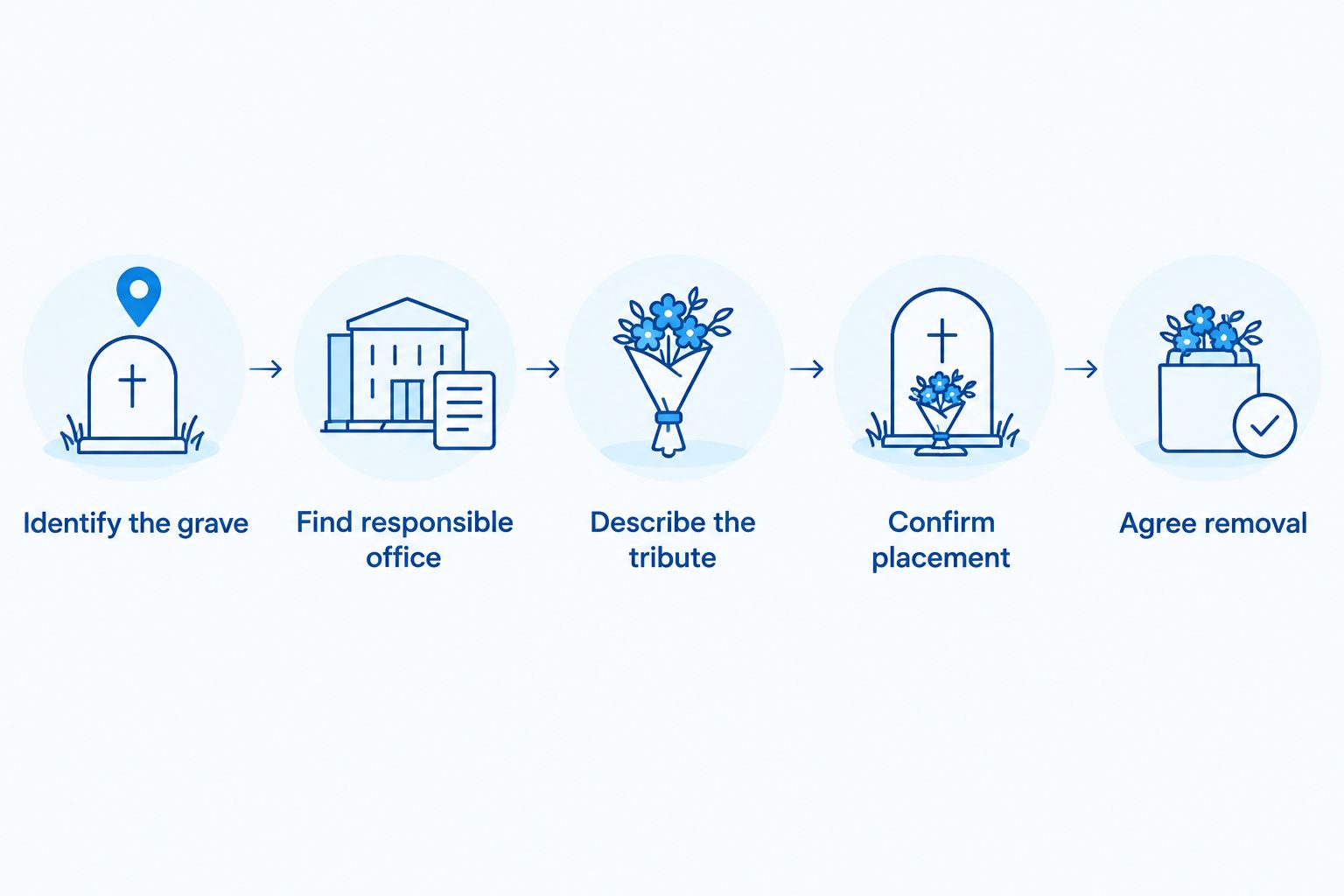
- Identify the grave. Note the cemetery or churchyard name, the person's name and any grave reference you have. Make clear whether your enquiry concerns an individual grave, a military plot or a memorial.
- Find the responsible office. Contact the burial-ground operator or CWGC as appropriate. If responsibility is shared, ask which organisation can confirm the relevant tribute rules.
- Describe the tribute. Say that the flowers are artificial or silk. Include whether the arrangement is loose, in a pot, on a wreath base or intended for attachment.
- Confirm placement. Ask exactly where it can sit. Check whether it must remain clear of the headstone, planting, paths or grass maintained by the grounds team.
- Agree removal. Ask whether you should take the tribute away after your visit, collect it later or follow a stated removal schedule. Keep the response with your visit details.
If you are organising a 2026 remembrance visit for relatives, share the answer before anyone orders flowers. A single agreed arrangement avoids different family members working from different assumptions.
A photograph or description of the proposed tribute can make the enquiry clearer. Do not interpret a reply about loose stems as approval for a weighted container or an attached wreath.
Why permission and placement vary
The decision concerns more than whether petals are fresh or artificial. These are the details to put in your enquiry rather than reasons to assume a particular restriction exists:
- Responsibility: establish whether the question belongs with CWGC, a council, a churchyard administrator or another operator.
- Location: distinguish the individual grave from a shared memorial, surrounding planting or communal tribute area.
- Material: describe the artificial flowers and any plastic, wire, ribbon or other components.
- Container: ask about pots, wreath bases and anything intended to hold the tribute upright.
- Placement and removal: explain whether the arrangement is for a visit, a ceremony or a longer stay.
For your 2026 enquiry, request the current written guidance where it exists. If the response is unclear, ask a narrower question about your proposed arrangement instead of treating silence as approval.
Should I choose silk flowers, fresh flowers or a wreath?
Choose the permitted format first, then the flowers that feel right for your family. Neither fresh nor artificial flowers are the correct emotional choice for everyone, and neither should be treated as automatically acceptable at every site.
| Option | Best for | Practical benefit | Limitation |
|---|---|---|---|
| Silk or artificial flowers | Families seeking a lasting tribute where permitted | They do not depend on watering to retain their floral form | Outdoor suitability varies; permission and eventual collection still matter |
| Fresh flowers | Families who value natural flowers | Natural texture and fragrance, depending on the flowers chosen | They wilt and need removal or replacement |
| A wreath | Families wanting a circular tribute | A distinct format for personal remembrance | Its base and fixings need checking; a wreath can contain fresh or artificial flowers |
A wreath is a shape, not a material. When asking for approval, specify whether it contains fresh or artificial flowers and describe the base rather than simply calling it a remembrance wreath.
Stemsfromheaven is best for families seeking handcrafted silk memorial tributes where artificial flowers are permitted. The retailer offers artificial funeral flowers, wreaths and grave pots; that choice does not replace checking the burial ground's requirements. You can consider Stemsfromheaven once the permitted format is clear.
Can I attach flowers to a war-grave headstone?
Do not attach flowers to a headstone without explicit permission. Ask specifically about ties, wire, adhesive, hooks or clips rather than assuming permission to leave flowers includes permission to fasten them to stone.
An attachment also changes how a tribute is removed. If the operator approves an arrangement beside the grave instead, follow that placement instruction rather than improvising a fixing during your visit.
Can I leave a poppy wreath for a remembrance ceremony?
Check the ceremony arrangements and the rules for leaving the wreath afterwards. Permission to lay a tribute during an organised event does not answer how long it should remain or who will collect it.
For a ceremony in 2026, ask the organiser where personal tributes belong and whether collection is arranged. Describe any artificial flowers, ribbon and supporting frame when checking the wreath.
What should I do if artificial flowers are not permitted?
Respect the restriction and ask which form of remembrance is accepted. Fresh flowers are an option only if the site permits them; taking a tribute home after a visit also needs to fit any rules about bringing it onto the grounds.
You can keep a silk arrangement at home as a personal memorial without leaving it at the grave. Choosing a different setting for the flowers does not diminish the care behind them.
FAQ
Are artificial flowers allowed on all UK war graves?
Do not assume artificial flowers are allowed on every UK war grave. Confirm the rules for the particular grave, including the arrangement’s material, container, placement and removal.
Who should I ask about flowers on a Commonwealth war grave?
Start with CWGC or the office responsible for the cemetery or churchyard. Establish who can confirm the rules for the grave itself and for the surrounding burial ground.
Can I leave a silk grave pot beside a military headstone?
Leave a silk grave pot only after confirming that both the artificial flowers and the container are permitted. Ask where the pot can sit and whether you must collect it.
Are fresh flowers always allowed instead of artificial flowers?
Do not assume fresh flowers are automatically permitted in every location or format. Check placement and removal requirements even when the flowers themselves are accepted.
Can I use wire to secure a wreath to a headstone?
Do not wire a wreath to a headstone without explicit permission. Ask about the proposed fixing separately from permission to leave the wreath.
Can Stemsfromheaven confirm whether my chosen war grave allows silk flowers?
Permission must come from the organisation responsible for the grave or burial ground. Stemsfromheaven supplies artificial floral tributes, but a retailer’s product description is not evidence of cemetery approval.
One last thing
Ask the removal question before choosing the tribute. Knowing whether you need to carry the arrangement home helps you choose a manageable format and avoids uncertainty at the end of an emotional visit.
For a 2026 visit, keep the relevant reply with your travel details. A clear placement and collection plan matters more than choosing flowers first.
Related guides
- Purple funeral flowers for a grave tribute
- Choosing grave flower pots by size
- Funeral wreaths by size