
Funeral Wreath Checklist: Planning a Funeral Service
Funeral wreaths are an important part of memorial services, symbolising eternal life and unbroken love. They are often used to honour the deceased and provide comfort to grieving families. Whether you’re choosing a wreath for a religious or non-religious ceremony, here’s a quick guide to help you make informed decisions:
- Purpose: Wreaths represent continuity and remembrance. In Christian traditions, they often symbolise the soul’s triumph over death.
- Types: Options include fresh, artificial, or planted wreaths. Fresh flowers offer a short-term tribute, while artificial or planted wreaths last longer.
- Shapes and Sizes: Circular designs are common, but heart or cross shapes are also popular. Typical sizes range up to 55cm in diameter.
- Personalisation: Include meaningful flowers, colours, or symbols that reflect the deceased’s personality or interests.
- Budget: Costs typically range from £30 to £100 for standard options, with bespoke designs costing more.
- Delivery: Order 7–10 days in advance and coordinate with the funeral director for proper placement.
Funeral wreaths are more than decorations – they are heartfelt tributes that honour and celebrate the memory of a loved one.
[5a] The funeral arrangement-wreath [ENG]
sbb-itb-2970de5
Choosing the Right Funeral Wreath
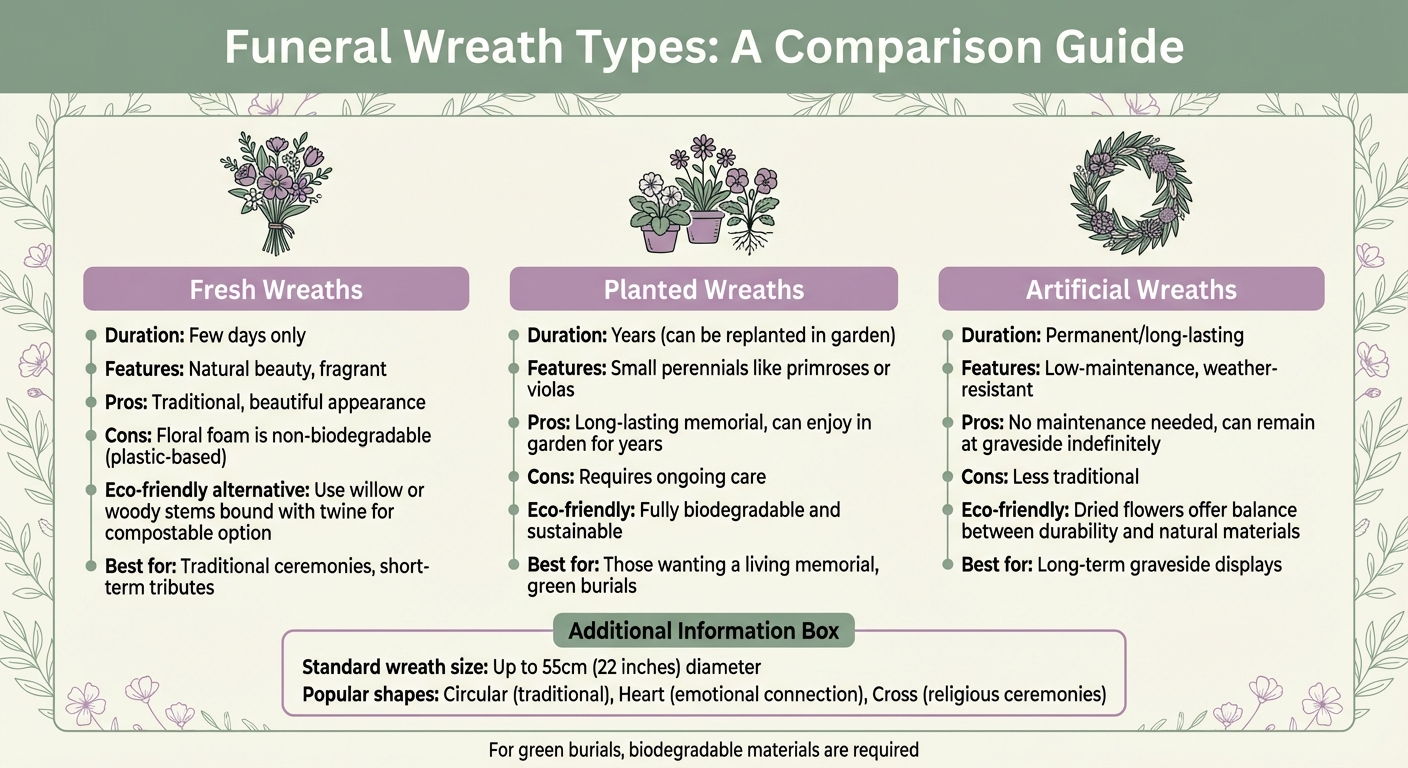
Funeral Wreath Types Comparison: Fresh vs Artificial vs Planted Options
Fresh vs Artificial Wreaths: Making the Decision
When selecting a funeral wreath, the choice between fresh and artificial materials depends on the tribute you wish to create. Fresh wreaths offer natural beauty and a fleeting, fragrant homage, lasting only a few days. If you’re looking for something more enduring, a planted wreath filled with small perennials like primroses or violas can be a meaningful option. As Gill Hodgson, Co-founder of The Farewell Flowers Directory, explains:
"Wreaths do, however, lend themselves perfectly to being filled with small plants which you can plant and enjoy your gardens for years to come" [1].
Artificial wreaths, on the other hand, provide a low-maintenance, permanent option, while dried flowers strike a balance with their durability and timeless charm. It’s worth noting that traditional fresh wreaths often rely on floral foam, which is plastic-based and non-biodegradable. For a more eco-conscious choice, consider wreaths made with willow or woody stems bound with twine, ensuring the entire arrangement is compostable [1]. This is especially important for green burials, where biodegradable materials are a requirement.
Once you’ve settled on the material, the next step is choosing the appropriate size, shape, and style to honour your loved one.
Selecting Size, Shape, and Style
Traditional funeral wreaths typically have a maximum diameter of about 55cm (22 inches), making them well-suited for placement atop a coffin [1]. The classic circular design remains a popular choice for such displays. For a more personal touch, heart-shaped wreaths are increasingly favoured as a way to express deep emotional connections, while cross-shaped designs are ideal for religious or spiritual ceremonies [2].
Colours also play a significant role in conveying sentiment. White symbolises purity, red represents deep love, yellow signifies friendship, pink conveys grace, and purple reflects dignity [3]. The arrangement’s style can further reflect the deceased’s personality. A structured, symmetrical design communicates formality and tradition, whereas a looser wildflower arrangement offers a more natural, contemporary feel [4]. For winter services, Gill Hodgson suggests focusing on foliage and texture:
"If sustainability and local provenance are at the heart of your choice for funeral flowers, a wreath is also perfect in winter months when the choice of outdoor-grown, local ingredients is limited" [1].
Personalising Wreaths to Reflect the Deceased
A personalised wreath can beautifully capture the essence of your loved one. Modern funeral wreaths go beyond traditional floral arrangements, allowing for creative customisation. For instance, incorporating non-floral elements like fruit, seedheads, or vegetables can reflect a gardener’s passion. Bespoke designs might include symbols such as football club badges or musical notes to honour specific interests [1]. Letter tributes, spelling out names or roles like "MUM" or "DAD", add a deeply personal touch.
You can also choose blooms based on their symbolism – lilies for peace, red roses for love, or yellow roses for friendship. Adding the deceased’s favourite colours or even the colours of a cherished sports team makes the tribute uniquely theirs. To enhance the arrangement, consider including a printed band or a memorial card nestled within the greenery. If your design requires rare flowers or intricate shapes, plan ahead and place your order 3–5 days in advance [5].
Determining Your Budget
Your budget will play a key role in deciding between standard arrangements and more personalised designs. In the UK, traditional funeral wreaths usually cost between £30 and £100, while bespoke tributes – like letter arrangements or themed designs – can run into several hundred pounds [6][7]. Cheryl Pyne from The Funeral Florist explains:
"The cost of funeral flowers can vary greatly, depending on several factors such as the type of arrangement, the size of the arrangement, and the flowers used." [6]
Premium flowers like lilies, roses, and orchids tend to be pricier than more common options such as carnations or chrysanthemums. Typically, immediate family members choose larger, more elaborate tributes, while friends and colleagues might opt for smaller posies or sheaves [6][7]. Pricing can also vary depending on location; for instance, London is often the most expensive, whereas Northern Ireland tends to be more budget-friendly [8]. To keep costs manageable, compare quotes from independent florists and consider seasonal flowers, which are often fresher and more economical [8].
Many families now choose artificial funeral flowers as a durable and cost-effective alternative to fresh blooms. Once you’ve set your budget, it’s time to think about delivery and logistics.
Delivery Timing and Logistics
To ensure availability and quality, provide your florist with seven to ten days’ notice when placing your order [10]. Arrangements like wreaths and casket sprays should be delivered to the funeral director’s premises on the morning of the service to ensure they are properly placed with the coffin [10][11]. Be sure to include the deceased’s name and the funeral date on the delivery label to avoid any mix-ups, and inform the funeral home in advance that flowers will be arriving [9]. As Esmee G, Founder of Order Of Service For Funeral Printing, notes:
"Notifying the funeral home in advance that flowers for the funeral will be sent to their location is a good idea." [9]
Confirm the delivery address with the funeral director, whether it’s the funeral home, a church, or a private residence. If ordering online, choose a florist that offers delivery status updates and follow up if you don’t receive confirmation [9].
With delivery sorted, clear communication with your florist becomes the next step.
Collaborating with Florists and Suppliers
To create the tribute you envision, communicate openly with your florist. Let them know your relationship to the deceased, as this can help determine the appropriate size and style of the arrangement [12]. Decide whether you prefer a natural, textured "Loose" design or a more structured "Based" arrangement [12]. Sharing details about the deceased’s hobbies or passions can also inspire unique, personal touches. If you’re prioritising eco-friendly options, ask for compostable frames made from natural materials like woody stems and twine instead of floral foam [1].
Take into account any religious or cultural practices. For example, white flowers are often used in Buddhist ceremonies, while some Jewish and Muslim traditions may favour charitable donations over floral tributes [11]. Confirm whether donations are preferred before ordering and ensure the florist has the funeral director’s contact information for seamless delivery [1][11]. Lastly, include a heartfelt message on the tribute card with your name clearly written so the family knows who sent it [11].
Displaying Funeral Wreaths at the Service
Where to Position Wreaths at the Ceremony
Once you’ve chosen and ordered funeral wreaths, displaying them thoughtfully is an important part of creating a respectful and meaningful service. Their placement often reflects both respect for the deceased and their unique personality.
Typically, the immediate family provides a coffin spray or a heart-shaped wreath, which becomes the focal point and is placed directly on top of the closed casket. Other wreaths, such as tied sheaves, are best displayed on low stands near the coffin.
For larger circular wreaths and floral sprays, easels are ideal, as they make the arrangements more visible to attendees. If the family prefers not to have floral tributes displayed indoors, consider asking the funeral director to arrange them outside – on a terrace, porch, or near the entrance – so they can still be seen by those arriving or leaving the service.
After the ceremony, attention usually shifts to arranging the floral tributes at the graveside.
Arranging Wreaths at the Graveside
Once the service concludes, funeral directors often transport the floral tributes to the burial site. At the graveside, wreaths can be placed flat on the grave, leaned gently against the headstone, or displayed on stands designed with pointed stems for secure placement in the ground. Avoid attaching wreaths directly to the gravestone, as this could obscure inscriptions or violate cemetery regulations.
"Funeral flowers from graveside burial services are usually removed in less than a week. Since fresh floral arrangements are typically used for a funeral, those displays are removed by the staff within a week." – Send-Off [13]
It’s always a good idea to check the specific rules of the cemetery beforehand. Some cemeteries may only allow fresh flowers, while others might permit silk arrangements or seasonal decorations. When positioning wreaths, ensure they don’t interfere with maintenance work, especially during the growing season. If you’ve chosen artificial funeral flowers in the UK from Stems From Heaven, their weather-resistant design allows them to remain at the site for extended periods, offering a lasting tribute without the need for frequent replacement.
Conclusion: Honouring the Deceased with Funeral Wreaths
Funeral wreaths hold a deep significance, serving as a heartfelt tribute that reflects the individuality and spirit of the person who has passed away. Their circular design symbolises eternal life and unending love, making them a meaningful choice for memorial services [15][14][17].
This guide has covered the key considerations for selecting the ideal funeral wreath. From choosing the type of wreath to working within a budget – typically ranging from £60 to £120 for traditional options in the UK [16] – and arranging delivery, every step plays a role in creating a fitting tribute. Above all, the wreath should honour the memory of the deceased. Whether you opt for bright, cheerful flowers to reflect a vibrant personality or select eco-friendly materials like willow frames for a more sustainable option, the choice should feel personal and heartfelt [4][1].
"Flowers have long been symbols of love, support, and remembrance, expressing feelings that words alone sometimes cannot capture." – Sabine Groven, Pure Cremation [4]
It’s also important to consider cultural or religious traditions before making a final decision. In some faiths, such as Judaism or Islam, flowers may not be customary for funerals [18]. Check with the family or refer to the funeral notice for guidance, especially if charitable donations are preferred instead [15][18].
A carefully chosen and thoughtfully arranged funeral wreath becomes more than just a decoration – it is a lasting expression of love, respect, and remembrance.
FAQs
Who should send the main funeral wreath?
The primary funeral wreath is typically sent by close family members or the immediate family of the deceased. This heartfelt gesture symbolises their profound bond with the departed and serves as a touching tribute to honour their memory.
Can I choose an eco-friendly funeral wreath?
Yes, you can choose a funeral wreath crafted from natural, sustainable materials such as willow, grapevine, moss, or even living plants. These options avoid plastic entirely and offer a thoughtful way to honour your loved one while caring for the environment.
What should I write on the tribute card?
When writing a tribute card for a funeral wreath, make it personal to express your feelings and connection with the person who has passed away. You might include their name, a treasured memory, or a simple yet heartfelt message of condolence, such as:
- "In loving memory"
- "Forever in our hearts"
- "With deepest sympathy"
The key is to keep it sincere and thoughtful, ensuring it honours their memory in a meaningful way.